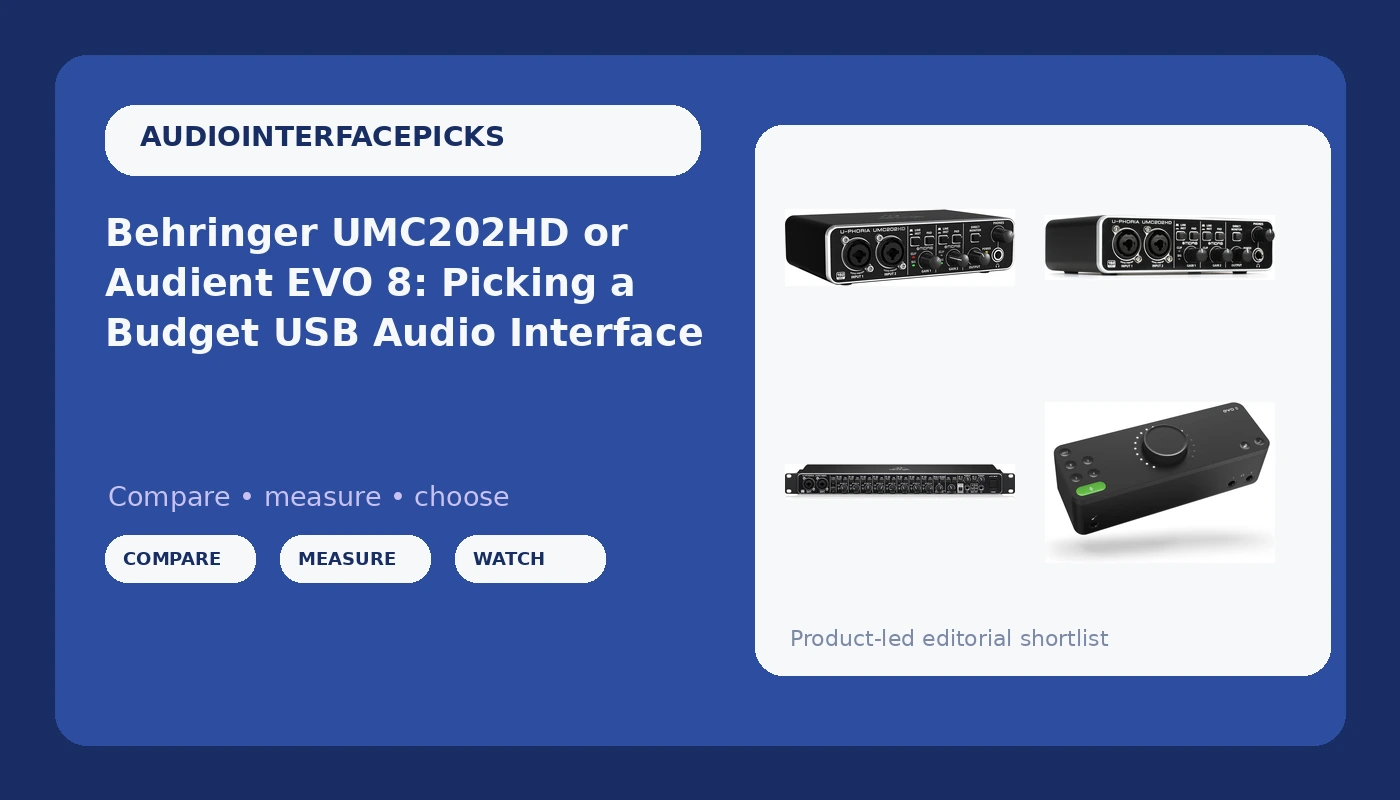
Shopping for a budget USB audio interface is mostly a counting exercise. Count the microphones and instruments you need running at the same time, count the ports on the laptop you actually record with, count the headphones you mix on, and the shortlist usually builds itself. The four listings below cover the two answers most home recordists land on: a compact 2x2 box for one or two sources at a time, and a larger multichannel interface for tracking a band or a drum kit. Two of the entries are the same Behringer model under two separate Amazon listings, which is worth knowing before you compare prices, and one is a step-up unit from Audient for anyone ready to spend more than entry level.
Related: How to Set Gain Staging on a Budget Interface →
Quick answer
If you record one or two sources at a time, a 2x2 interface such as the Behringer UMC202HD covers the job, and it appears here twice because Amazon carries more than one listing for that model, so compare both before buying. If you track drums, a full band, or want to add external preamps over ADAT later, the Behringer UMC1820 is the multichannel option in this group. If you want to move up out of entry-level hardware into a more expensive USB interface, the Audient EVO 8 is the step-up pick. None of these is the right answer in the abstract. Input count, driver support for your operating system, and how the preamps behave at the gain you actually use decide it.
Four useful options
| Model | Best fit | What stands out |
|---|---|---|
| Behringer UMC202HD (2x2, 24-Bit/192 kHz, Midas preamps) | One or two mics or instruments at a time | 2 in / 2 out, 24-bit/192 kHz conversion, Midas mic preamplifiers |
| Behringer UMC202HD (second listing) | The same job, at whichever listing is cheaper today | Same model and features under a separate Amazon listing |
| Behringer UMC1820 (18x20, Midas preamps, ADAT) | Bands, drum tracking, and anyone expanding later | 18x20 I/O, MIDI, ADAT I/O, Midas mic preamplifiers |
| Audient EVO 8 | Moving up from entry-level 2x2 hardware | Audient EVO series USB interface in a higher price bracket |
The budget 2x2 pick: Behringer UMC202HD
A 2x2 interface means two analog inputs and two analog outputs. In practice that is one microphone and one instrument at the same time, or a single stereo source, plus a pair of outputs for monitors and a headphone jack for tracking. For a singer-songwriter, a podcaster with one guest in the room, or anyone recording guitar parts one at a time, that is enough hardware. Where the 2x2 format stops working is the moment you want a stereo pair of overheads plus a kick mic, or three people talking on separate channels. Then you are not shopping for a better 2x2, you are shopping for more inputs.
The two things worth checking before you commit to this class of interface are driver support and monitoring. Sample rate numbers on the box tell you what the converter can do, not how stable the connection will be on your machine, so look at the manufacturer's current driver page for your operating system and read what other users of that OS report. Monitoring matters just as much: the headphone amp is the spec nobody reads until a quiet mix starts to distort, and a pair of high-impedance headphones will expose it faster than anything else.
The same model, listed twice: Behringer UMC202HD
Duplicate listings are common on large marketplaces, and the UMC202HD is a good example. Both entries describe the same interface with the same feature set, so there is no sonic difference to choose between and no reason to pay more for one over the other. What does differ is the listing itself: price, stock, seller, and shipping terms can all move independently, which is exactly why both appear here rather than a single link. Open both, compare the total delivered cost, and check who is actually selling and fulfilling. If one listing looks like a marketplace seller with a thin history, the other is the safer click.
One caution that applies to either listing: the specs are identical, so any claim you see on one page about a different chip, a different preamp, or a "new version" deserves a second look against the manufacturer's own product page. The model name is the thing to match, not the marketing copy.
The multichannel pick: Behringer UMC1820
The UMC1820 is the point where a home studio stops being a two-channel setup. Eighteen inputs and twenty outputs covers a drum kit with room to spare, and it leaves channels open for bass, guitars, and scratch vocals at the same time. That matters more than it sounds: tracking a band live means every player needs a channel, and re-amping or overdubbing later is far easier when the interface has room for it. It also carries MIDI, which is useful if a keyboard or a controller is part of the rig.
ADAT I/O is the feature that separates this from the smaller units. ADAT is an optical connection that carries additional channels into the interface, which means an external preamp or converter can be added later without replacing the interface itself. That is the practical argument for buying more I/O than you need today: the box grows with the studio instead of capping it. The trade-offs are physical. An 18x20 interface takes up rack or desk space, needs more cabling, and generally asks more of the computer's USB port than a 2x2 unit, so plan the port and the power situation before it arrives.
The step-up pick: Audient EVO 8
The EVO 8 is here for the buyer who has outgrown a first interface rather than the buyer looking for the cheapest way in. It sits above the Behringer models on price, and Audient's reputation in the interface market rests on its preamp design, which is the part of the chain that shapes the sound most before the converter ever sees the signal. If you are choosing between a second budget 2x2 and one better-built unit, the honest answer is that the better-built unit usually serves you longer, provided it has the channel count you need.
Before buying, verify the details that matter for your setup directly on the listing: the exact number of mic preamps, whether the inputs you need are combination jacks, whether there is an instrument-level DI input for guitar and bass, and what the monitoring options look like. Those specifics change how a unit fits a workflow far more than a brand name does, and they are the questions worth asking before you commit a larger budget to one box.
Prices and availability may change. Product images, names, and retailer links are matched to verified listings. No current price, rating, stock status, or measured result is stated here without current evidence.
What the specs on the box actually mean
Sample rate and bit depth describe the converter: 24-bit/192 kHz is the current ceiling on all of the Behringer units listed here, and it is far above what most home recordings need. A 24-bit/48 kHz session is standard practice for music and speech, and higher rates cost you file size and CPU without an audible payoff in a typical untreated room. Treat the number as a capability, not a quality score.
The preamp is the part of the interface that shapes the sound before anything is digitized. "Midas mic preamplifiers" tells you the design lineage of the circuit in the Behringer units, and a brand like Audient carries its own preamp reputation. Neither statement tells you how a preamp behaves at three o'clock on the gain knob with a low-output dynamic mic, which is where cheap preamps reveal themselves. That is a question for real recordings, not for a spec sheet.
Input and output counts are the most useful numbers on the box. An 18x20 interface means eighteen channels in and twenty out, which sounds excessive until you try to track a five-piece band. ADAT I/O is expansion headroom. MIDI is for controllers and hardware synths. None of these specs make a recording sound better on their own; they determine what you can plug in at the same time.
Drivers are the invisible spec. A converter can be excellent and the experience can still be miserable if the driver is unstable on your operating system or resets your settings on reboot. Check the manufacturer's driver page for your OS version before you buy, and read recent user reports from people running hardware similar to yours.
How many inputs do you actually need
- Write down every source you want to record simultaneously, not every source you own. One vocalist and one guitar is two channels. A drum kit with kick, snare, and two overheads is four before you add anything else.
- Add one spare channel to that number. Spares get used for a talkback mic, a room mic, or a second instrument far more often than people expect.
- Decide whether you need stereo pairs. Stereo overheads, stereo keys, and stereo room mics each consume two channels, which pushes a 2x2 interface out of the running quickly.
- Check the computer side. Confirm the USB port type, whether the interface can run on bus power alone, and whether the driver is current for your operating system.
- Check the monitoring side last. Count the output pairs you need for monitors and the headphone jacks you need for tracking, and make sure the headphone amp can drive the impedance of the cans you actually use.
Practical guidance for buying one of these
- Buy input count for the session you record most often, not the session you dream about. A 2x2 covers solo work; an 18x20 covers a band.
- Set gain so the meter reaches a healthy level without clipping, then listen. The preamp decision is made with your ears, not by comparing spec sheets.
- Match the interface to the port you have. Older laptops with flaky USB ports are a poor home for a multichannel unit that expects a steady connection.
- Plan for drivers before you plan for plugins. Install the current driver, confirm the buffer size you can run without dropouts, and only then judge the latency.
- Keep headroom in your budget for the parts that actually change the sound: the microphone, the room treatment, and the monitoring. The interface is one link in that chain.
Which option should you choose?
Choose the Behringer UMC202HD when you record one or two sources at a time and want the simplest 2x2 path into a computer, comparing both listings before you buy. Choose the second UMC202HD listing when it is the cheaper or better-fulfilled of the two for the identical model. Choose the Behringer UMC1820 when you track drums or a full band, or when you want ADAT I/O so external preamps can be added later. Choose the Audient EVO 8 when you have outgrown entry-level hardware and would rather spend more once on a unit from a dedicated interface maker.
Nothing here is a measured comparison. The distinctions in this article come from the product listings themselves, meaning input and output counts, conversion specifications, preamp branding, and connectivity. Driver stability, headphone amp behavior, and preamp character at high gain are all things you should verify for your own machine and your own microphones before you spend.
The bottom line
The Behringer UMC202HD is the sensible starting point for solo recording and simple podcast setups, and because the same model appears under two listings, the buying decision there is about price and seller rather than features. The UMC1820 is the answer when channel count and ADAT expansion matter more than a small footprint. The Audient EVO 8 is the step up for anyone ready to leave entry-level hardware behind. Count your simultaneous sources, confirm driver support for your operating system, check the headphone amp against your headphones, and buy the interface that fits the sessions you actually run.