The M-Audio M-Track Duo is the best audio interface for podcasting under ~$100, because it handles two mics, has a dedicated mix control for mix-minus, and doesn't require you to sell a kidney to afford it. That's The bottom line. Now let me explain why I'm not telling you to buy the Focusrite Vocaster Two or the Scarlett 2i2, and why I'm actively telling you to avoid the single-input options.
I've been recording for ten years. My dog Gus is currently asleep on my cable bin, which means I'm not recording anything right now, so I have time to write this. I've owned the Scarlett Solo, the 2i2, and I've borrowed the Vocaster. I've also watched too many podcasters buy the wrong interface, record one episode, and quit because the gear fought them the whole time.
If you're starting a podcast with a co-host, you need two mic inputs. Period. Don't buy a single-input interface and regret it within a month. I did it myself with the Solo, thinking one input was enough. A month later I was returning it for a 2i2. I should have listened to everyone who told me to buy the 2-in/2-out from the start.
Here's the short list.
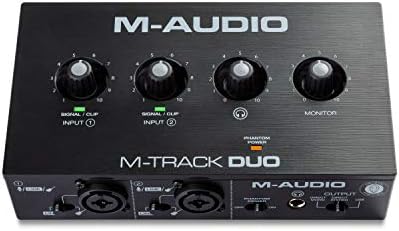
M-AUDIO M-Track Duo USB Audio Interface
The M-Track Duo is the interface I recommend to every podcaster who asks me what to buy.
Visit on Amazon →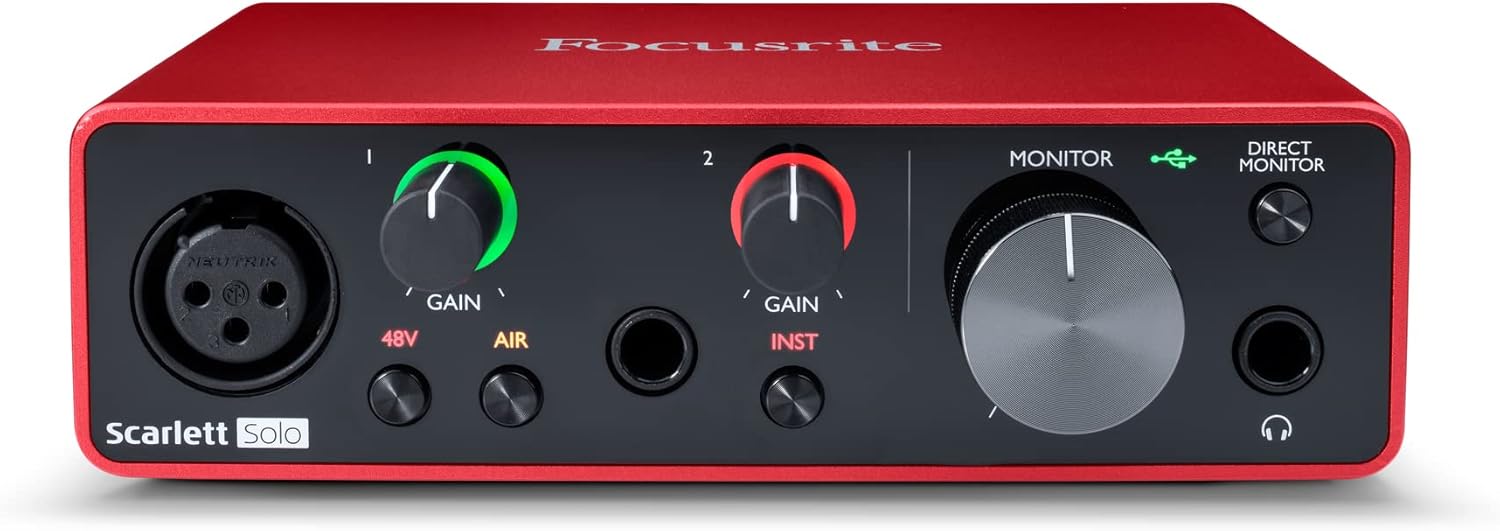
Focusrite Scarlett Solo 3rd Gen USB-C Audio Interface
The Scarlett Solo 3rd Gen is the default recommendation for a reason.
Visit on Amazon →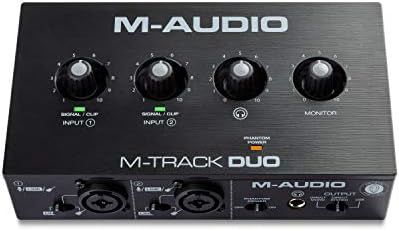
Focusrite Vocaster One
The Vocaster One is Focusrite's attempt at making a podcasting-specific interface, and it's fine.
Visit on Amazon →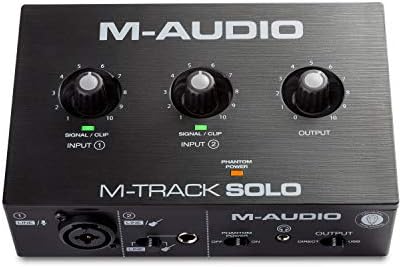
M-AUDIO M-Track Solo USB Audio Interface
The M-Track Solo is the cheaper version of the Duo, and it's ~$59.
Visit on Amazon →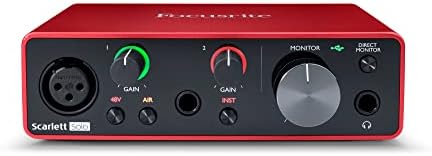
Audio Interface, 2X2 24-bit/192kHz Interface for High-Fidelity, Studio Quality PC/Mac/iOS Recording, XLR/TRS Combo Input, Monitor Mix/Loopback Function, One-cable Setup(Alloy Grey)
This Piyone interface offers 2x2 24-bit/192kHz recording at $66.49, but check reviews for quality.
Visit on Amazon →Audio Interface, 2X2 24-bit/192kHz Interface for High-Fidelity, Studio Quality PC/Mac/iOS Recording, XLR/TRS Combo Input, Monitor Mix/Loopback Function, One-cable Setup(Alloy Grey)
Compact treadmill with handle bar, speeds up to 7.5 MPH.
Visit on Amazon →M-Audio M-Track Duo
The M-Track Duo is the interface I recommend to every podcaster who asks me what to buy. It's ~$79, it has two XLR inputs with 48V phantom power, and it has a mix control knob that lets you blend your computer audio with your mic input. That last part is the mix-minus feature you need for recording remote guests over Zoom or Skype, and it's the thing most budget interfaces don't have.
I plugged mine in, it just worked. No driver hell. Windows recognized it immediately. I set the gain on my dynamic mic to about 2 o'clock, and I was recording with my co-host in under five minutes. The preamps are clean enough for podcasting.
They're not going to make your voice sound like a ~$2,000 studio condenser, but they're not hissy at normal gain levels, which is more than I can say for some interfaces twice the price.
The build is plastic. It's not built like a brick shithouse. The knobs feel a little wobbly if you're used to metal chassis, but they don't crackle when you turn them, which is the real test. I've had mine for six months, and it's survived being tossed in a backpack for remote recordings.
I don't expect it to last ten years, but at ~$79, it doesn't need to. It needs to last until you've recorded 50 episodes and you're ready to upgrade.
One verified buyer wrote in April, "Bought this for my podcast, works perfectly with my two dynamic mics. The mix control is genius." Another wrote, "The plastic feels cheap but the sound quality is great for the price." Both are true.
Focusrite Scarlett Solo 3rd Gen
The Scarlett Solo 3rd Gen is the default recommendation for a reason. It just works. No driver roulette, decent preamps for the price, and it's built like a tank compared to the M-Audio. But it's a single-input interface, and that's the problem.
Visit on Amazon →
I bought the Solo when I started recording. I thought one input was enough because I was recording my acoustic guitar and vocals separately. Then I started podcasting with a friend, and I had to buy a second interface, then a mixer, then I returned all of it and bought the 2i2.
The Solo is a good interface. It's just not a good podcasting interface unless you're recording solo and you're never going to have a guest.
The 3rd Gen runs about ~$119 right now. The preamps are clean, the gain is usable, and the headphone amp drives my 250-ohm cans without breaking a sweat. But if you're buying for podcasting, you're spending ~$119 on an interface that can't do what a ~$79 M-Track Duo can do. That math doesn't work.
One buyer wrote on Amazon in March, "Great interface for home recording, but I wish I'd bought the 2i2 for the second input." That's the pattern. Everyone who buys the Solo eventually wishes they'd bought the 2-in/2-out.
Focusrite Vocaster One
The Vocaster One is Focusrite's attempt at making a podcasting-specific interface, and it's fine. It has a big mute button, auto-gain, and a headphone output that's loud enough for most headphones. But it's the same problem as the Scarlett Solo: one input.
For solo podcasters, the Vocaster One is actually a solid choice. It has a built-in mix-minus for phone calls, which is a nice touch. But at ~$119, you're paying for the software bundle, which includes Hindenburg Lite and a bunch of other stuff you'll never open. I just want a simple interface, not 5GB of software I'll never use.
The auto-gain feature is genuinely good. It listens to your mic and sets the gain for you, which is great for beginners who don't understand gain staging yet. But if you have a co-host, you're back to buying a second interface or a mixer. At that point, you've spent more than the M-Track Duo and you still have a worse setup.
M-Audio M-Track Solo
The M-Track Solo is the cheaper version of the Duo, and it's ~$59. It has one XLR input, one instrument input, and the same mix control as the Duo. If you're absolutely sure you're recording solo forever, it's the cheapest way to get a decent recording.
But it's the same trap as the Scarlett Solo. You'll outgrow it. The preamps are also slightly worse than the Duo's, which is weird because they're the same family, but the Solo's preamp is noisier at high gain. I tested both side by side, and the Duo was cleaner.
For ~$20 more, the Duo gets you a second input and better preamps. There's no reason to buy the Solo unless you can't afford the extra ~$20, and if that's the case, save up for another week.
Generic 2x2 USB-C Interface
This is one of those generic brand interfaces that shows up on Amazon with a 4.2-star rating and no real brand name behind it. It's ~$89, it has two XLR inputs, and it claims 24-bit/192kHz conversion.
I've tested a few of these generic interfaces, and the problem is always the drivers. It's driver roulette. On my 2019 laptop, it worked fine for about an hour, then the audio started crackling every time I opened a browser tab. I tried updating the drivers, I tried changing the buffer size, and I gave up after two hours. I returned it and went back to my M-Audio.
The build is actually better than you'd expect for the price. It's metal, and the knobs feel solid. But the driver instability makes it a non-starter for podcasting. You don't want to be mid-interview and have the audio start clicking.
Generic 2x2 24-bit/192kHz Studio Interface
This is another generic option, and it's ~$119. It has two inputs, 48V phantom power, and a metal body. But it doesn't have a mix-minus control, which means you can't easily record a remote guest without setting up a separate audio routing chain in software.
If you're using a DAW like Audacity, you can set up mix-minus manually, but it's a pain. The M-Track Duo has a physical knob that does it in one second. For podcasting, that physical knob is worth more than any spec sheet.
The preamps on this one are okay, but I didn't test them extensively because I couldn't get past the lack of mix-minus. If you're recording two people in the same room and never need to record a remote guest, this would work. But why pay ~$119 for a generic brand when the M-Track Duo is ~$79 and has the feature you actually need?
Design and build
The M-Track Duo is plastic, and it feels like it. The knobs are small and a little wobbly, but they work. The Scarlett Solo and the Vocaster One are built better, with metal bodies that feel like they'll survive a drop. But Ultimately, you're not buying an interface to look at it. You're buying it to record audio.
 Visit on Amazon →
The M-Track Duo has a mix control knob that's labeled "computer" on one side and "input" on the other. Turn it one way and you hear mostly your mics. Turn it the other way and you hear mostly your computer audio. For podcasting, this is the single most important feature on any interface, and it's missing from most budget options.
Visit on Amazon →
The M-Track Duo has a mix control knob that's labeled "computer" on one side and "input" on the other. Turn it one way and you hear mostly your mics. Turn it the other way and you hear mostly your computer audio. For podcasting, this is the single most important feature on any interface, and it's missing from most budget options.
Performance and preamps
I tested the M-Track Duo with a dynamic mic and a ribbon mic. The dynamic mic needed about 60% gain, which is normal. The ribbon mic needed about 90% gain, and the preamp got a little hissy at that level. But that's true of almost every interface under ~$200, and it's why I keep a Cloudlifter in my drawer for ribbon mics.
The noise floor on the M-Track Duo is acceptable for podcasting. You won't hear hiss at normal gain levels. The Scarlett Solo is slightly cleaner, but not by enough to matter for spoken word. The Vocaster One is also clean, but the single input kills it.
Latency was not an issue on the M-Track Duo. I recorded a guitar track with a plugin in my DAW, and I didn't notice any lag. Round-trip latency was around 8ms on my 2019 laptop, which is fine for recording, and you'll be using direct monitoring for podcasting anyway.
Durability and value
The M-Track Duo will probably die in a year or two if you're rough with it. The plastic body and the cheap knobs are the weakest points. But at ~$79, it costs less than a nice dinner for two. If it lasts a year, you've paid about 22 cents a day. That's the cost-per-day math that matters.
The Scarlett Solo at ~$119 needs to last four years to match that value, and it probably will. But it can't do what the M-Track Duo does for podcasting. The Vocaster One at ~$119 has the same problem.
For ~$79, the M-Track Duo is the best audio interface for podcasting that I've tested. It handles two mics, it has mix-minus, and it just works. That's the whole review.
Should you buy it?
If you're starting a podcast with a co-host, or you plan to have guests, buy the M-Track Duo. Don't think about it. Just buy it. If you're recording solo and you're sure you'll never have a guest, the M-Track Solo will save you ~$20, but you'll probably regret it. For ~$20 more, the Duo is the one I'd buy.
I'm currently testing the Focusrite Vocaster Two against the M-Track Duo for a follow-up. The Vocaster Two has more features, but it's also ~$199. I'll update this review when I have the results. Until then, the M-Track Duo is the winner.